Expert Talk Series on Computational Complexity and Streaming Algorithms
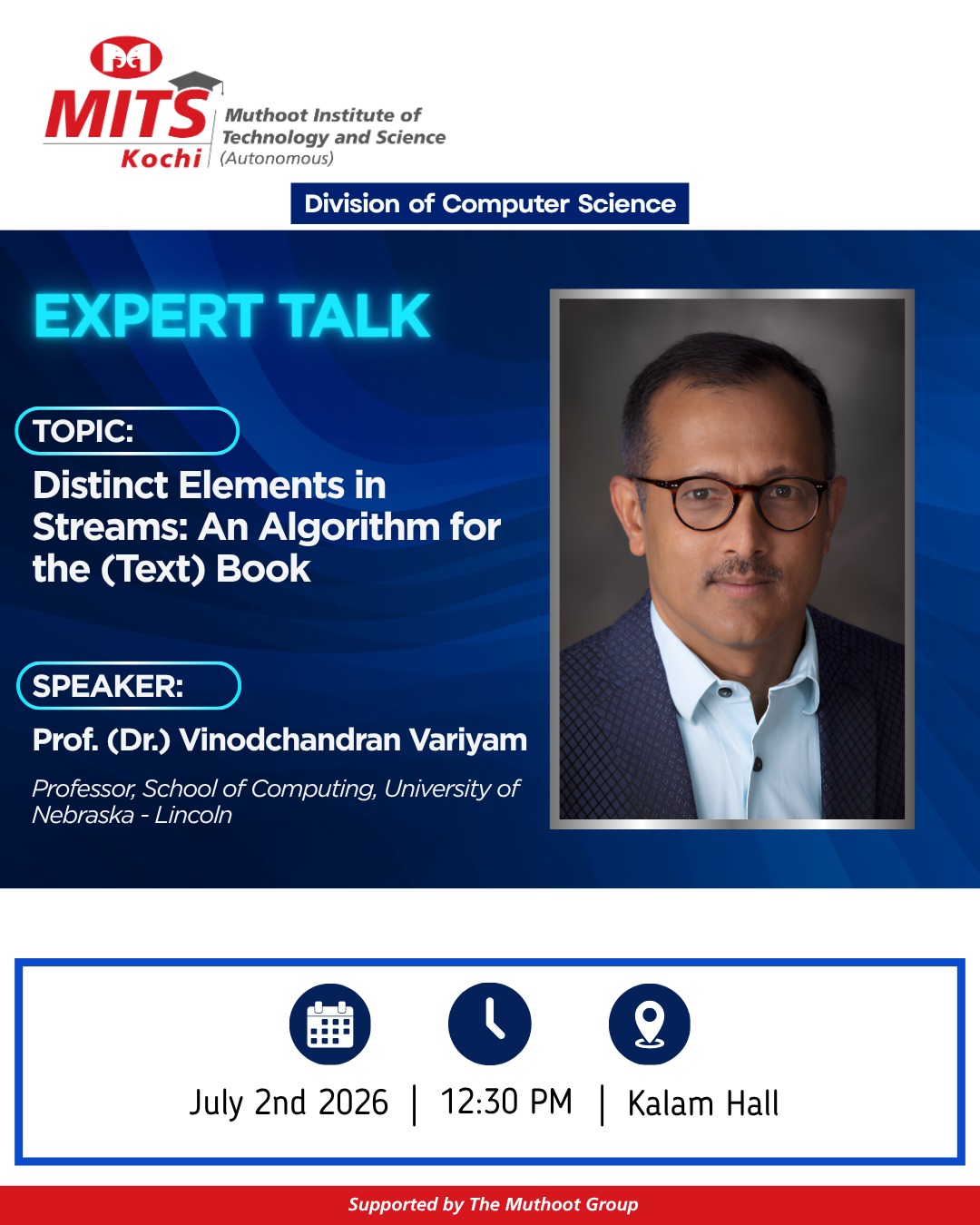
The Division of Computer Science, Muthoot Institute of Technology and Science (Autonomous), Kochi, organized an Expert Talk Series on 2nd July 2026, featuring Prof. (Dr.) Vinodchandran Variyam, Professor, School of Computing, University of Nebraska–Lincoln, USA. The programme comprised two expert sessions aimed at exposing students and faculty members to contemporary research in theoretical computer science, computational complexity, and streaming algorithms.
Prof. (Dr.) Vinodchandran Variyam is a distinguished researcher in the School of Computing, University of Nebraska–Lincoln, USA, whose research spans Reproducibilty in Randomized Computations ,Sample Efficiency in Learning
and Testing: of high-dimensional distributions, and algorithms for streaming data. His pioneering contributions have been recognized through publications in premier international conferences such as NeurIPS, ICML, STOC, PODS, ICLR,AAAI, and IJCAI, and his CVM Algorithm has received international recognition for its impact on data stream processing.
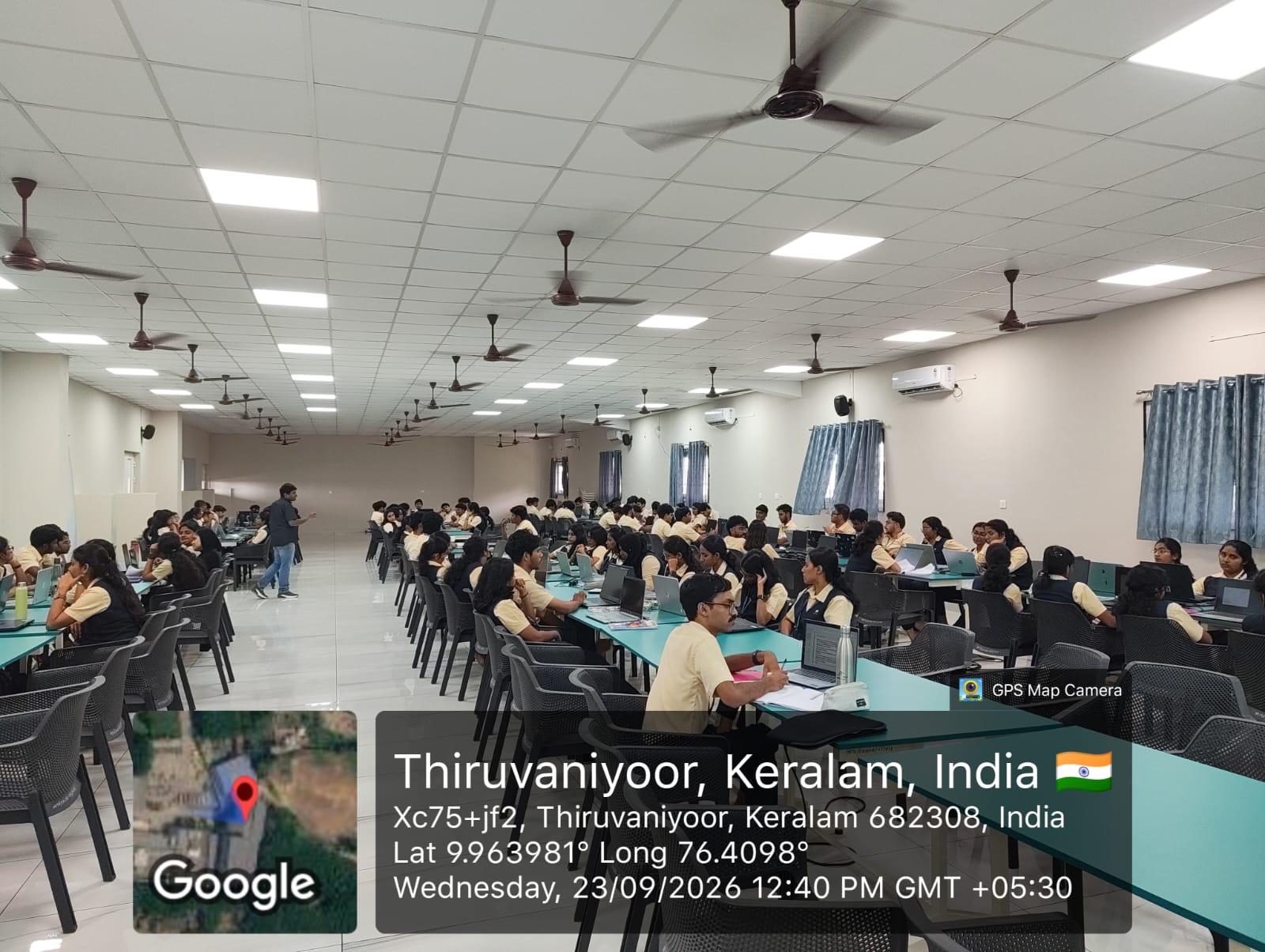
The first session,Complexity Theory: Understanding Computational Scalability, was attended by nearly 200 students from the Computer Science and Engineering programme and allied branches. The lecture introduced participants to the concepts of computational scalability, the limits of scalability, the relationship between computational complexity and algorithmic efficiency, and the use of Fermi estimation for approximating large-scale computational problems.
The second session, Distinct Elements in Streams: An Algorithm for the (Text) Book, was conducted for around 30 faculty members. The session focused on the CVM (Chandramouli–Vinodchandran–McGregor) algorithm for estimating distinct elements in streaming data and highlighted the importance of randomized algorithms for efficient large-scale data processing. Through these expert lectures, participants gained valuable exposure to emerging research directions in computational complexity, streaming algorithms, machine
learning, and data-intensive computing. The programme served as an excellent platform for fostering academic curiosity, encouraging research-oriented thinking,and strengthening the participants' understanding of advanced concepts in computer science.




.jpg)

.jpg)